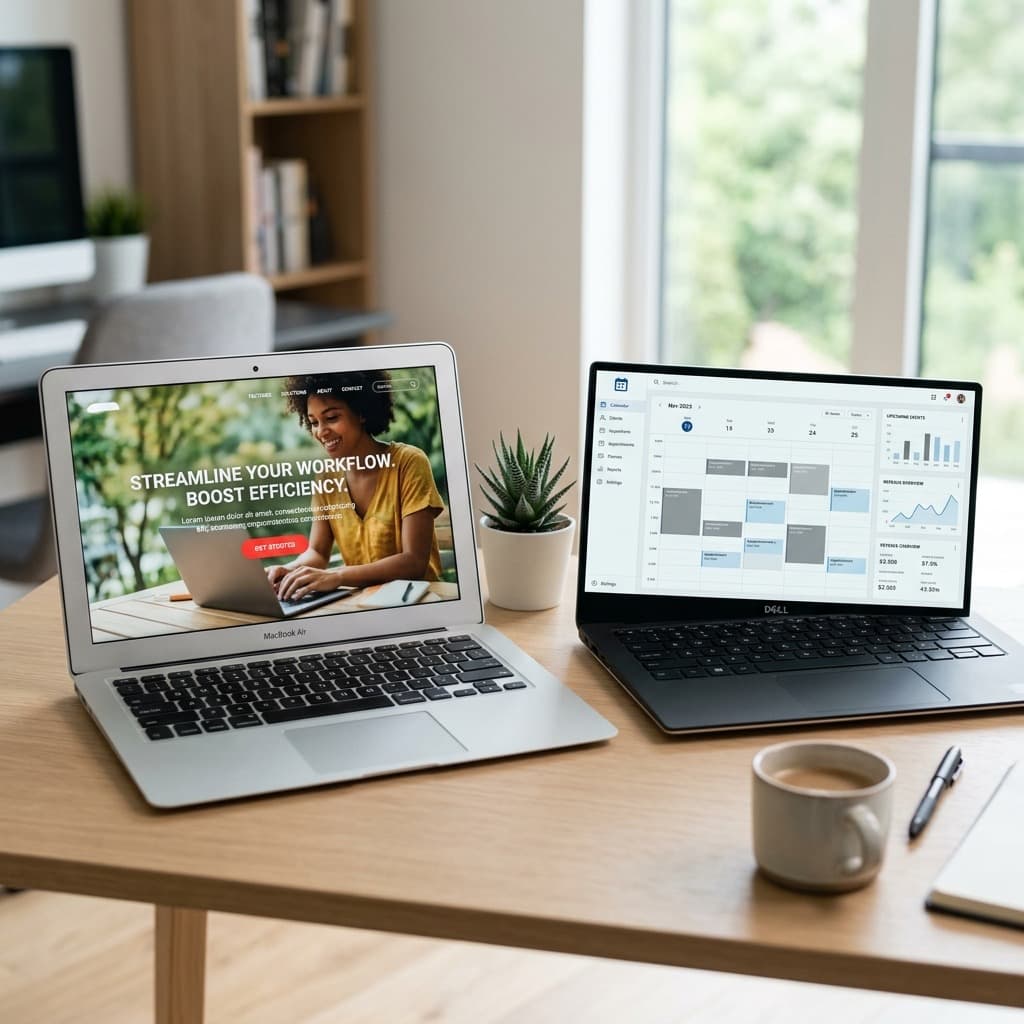
Website vs. Web App: Which Does Your Small Business Actually Need?
Tanvir Mahedi
Author
"Website" and "web app" get used interchangeably in casual conversation, but they're built differently, priced differently, and solve different problems. Confusing the two is the most common reason small businesses end up either overpaying for something they didn't need, or underbuying something that can't do what they actually wanted.
What a Website Actually Does
A website mainly presents information. Visitors read it — service pages, an about page, a portfolio, a blog. The primary interaction is usually a contact form or a click-through to get in touch. Websites are what most small businesses need: a professional, fast, easy-to-find presence that explains what you do and how to reach you.
What a Web App Actually Does
A web app lets users do something, not just read something. Visitors log in, book something, calculate something, or manage data. The interaction is the point — the app isn't finished until the user has accomplished a task inside it, not just read a page.
Real Examples
- Booking tool: a client picks an available time slot and books it directly — that's a web app, not a page.
- Client portal: customers log in to check order status or view documents — a web app.
- Pricing calculator: a visitor enters details and gets a custom estimate — a small but real web app.
- Internal dashboard: your team logs in to track something (inventory, leads, schedules) — a web app, even if customers never see it.
- Service pages describing what you offer: that's a website, even if it looks polished and modern.
A Simple Framework for Deciding
Ask yourself: does a visitor need to read something, or do something that changes state (books a slot, submits data that gets processed, logs into an account)? If it's read-only, you need a website. If someone needs to interact with data and get a result specific to them, you're looking at a web app — even a small one. There's no universal statistic that tells you which category your business falls into — this is a judgment call based on what your customers actually need to accomplish, not a decision you can outsource to a benchmark.
Signs You're About to Overbuild
Not every "I wish customers could just book online" thought needs a custom web app on day one. If a single embeddable booking widget, a well-configured off-the-shelf calendar tool, or even a well-organized contact form covers 90% of what you need, building custom is often solving a problem you don't have yet. The signal to watch for: are you asking for a custom build because an off-the-shelf tool genuinely can't do what you need (custom logic, a specific user role structure, data that has to live in your own system) — or because a custom build sounds more impressive? The first is a real reason. The second usually means you're not ready to spend on custom development yet.
How to Scope a Smaller v1
When a web app is genuinely the right call, the biggest cost risk isn't the concept — it's trying to build every feature you can imagine before launch. A smaller, well-scoped first version does one thing well: a booking tool that handles scheduling but not payment processing yet, a client portal that shows order status but not full document history yet. Ship that, see how it's actually used, then add the next layer as a separate, quoted phase based on real usage rather than guesses made before anyone touched it. This isn't a corner-cutting compromise — it's how experienced teams reduce the risk of spending months building features nobody ends up needing.
You Might Need Both
Plenty of small businesses need a marketing website and a small web app bolted onto it — a booking calendar embedded in an otherwise standard website, for example. That's normal, and it doesn't mean starting over: a well-built website can have a web app feature added to it later without a full rebuild, as long as the original site was built on a modern, maintainable stack rather than a rigid template.
Keep reading
How Much Does a Website Redesign Cost? A Small Business Guide
The honest answer is "it depends" — but here's what real industry survey data says small businesses actually spend, and why the cheapest option often costs more in the long run.
What Is AI-Assisted Development? (And Why It's Faster, Not Riskier)
"AI-built" sounds risky if you picture code with zero human oversight. That's not what this is — and the real research on AI coding tools is more nuanced than either the hype or the skepticism suggests.
What Website Downtime Actually Costs a Small Business
A few hours of downtime sounds like a minor inconvenience — until you look at what it actually costs, and how often it happens to sites nobody's watching.
How Often Should a Small Business Blog? What the Data Actually Says
"Post more" isn't wrong, but it's not the whole answer either — here's what the actual traffic data says about how often a small business should be publishing.
Schema Markup Explained: How AI Search Engines Decide What to Cite
Getting cited by ChatGPT or Perplexity isn't random — there's a specific, well-documented technical reason some pages get picked as sources and others don't.
Core Web Vitals Explained: What Google Actually Measures
"Site speed matters for SEO" is old advice. What changed is that Google now measures it with three specific metrics — and in 2026, missing the bar has a real, measurable ranking cost.
Website Maintenance Checklist: What Actually Needs to Happen Every Month
"Set it and forget it" is how most small-business websites get hacked or quietly break. Here's what monthly maintenance actually involves, and how long it really takes.
Website Builder vs. Custom Development: When Templates Stop Working
A $30/month website builder isn't always the cheap option it looks like. Here's the honest math on when a template is genuinely fine, and when it starts actually costing you.
AI Product Photography: What It Can't Replace About a Real Photo Shoot
AI product photography is genuinely good — and genuinely limited. Here's an honest breakdown of what it replaces, what it doesn't, and why the best results mix both.
Brand Identity and Website Design: Why They Should Be Done Together
A logo from one designer and a website from someone else, six months apart, is one of the most common — and most avoidable — ways small businesses end up with a brand that fights itself.
How to Choose a Web Design Agency: Real Red Flags to Watch For
Most bad agency hires were avoidable — the warning signs were visible before signing, just easy to miss if you don't know to look for them.
Landing Page vs. Homepage: Which Should Get Your Ad Traffic?
Sending ad traffic to your homepage instead of a dedicated landing page is one of the most common — and most measurable — ways small businesses quietly waste ad spend.
What a Freelancer or Photographer Portfolio Site Actually Needs
A beautiful gallery of work isn't a complete portfolio site — here's what's actually missing from most freelancer and photographer sites, and why it's costing them clients.
"AI-Drafted, Human-Edited": What That Workflow Actually Means
"AI-drafted, human-edited" gets said a lot without much explanation of what it actually means — here's the real workflow, and why the human part is doing more work than it sounds like.
Related services
Let's build something that works.
Tell us about your project — we'll get back to you with a straight answer, not a sales pitch.