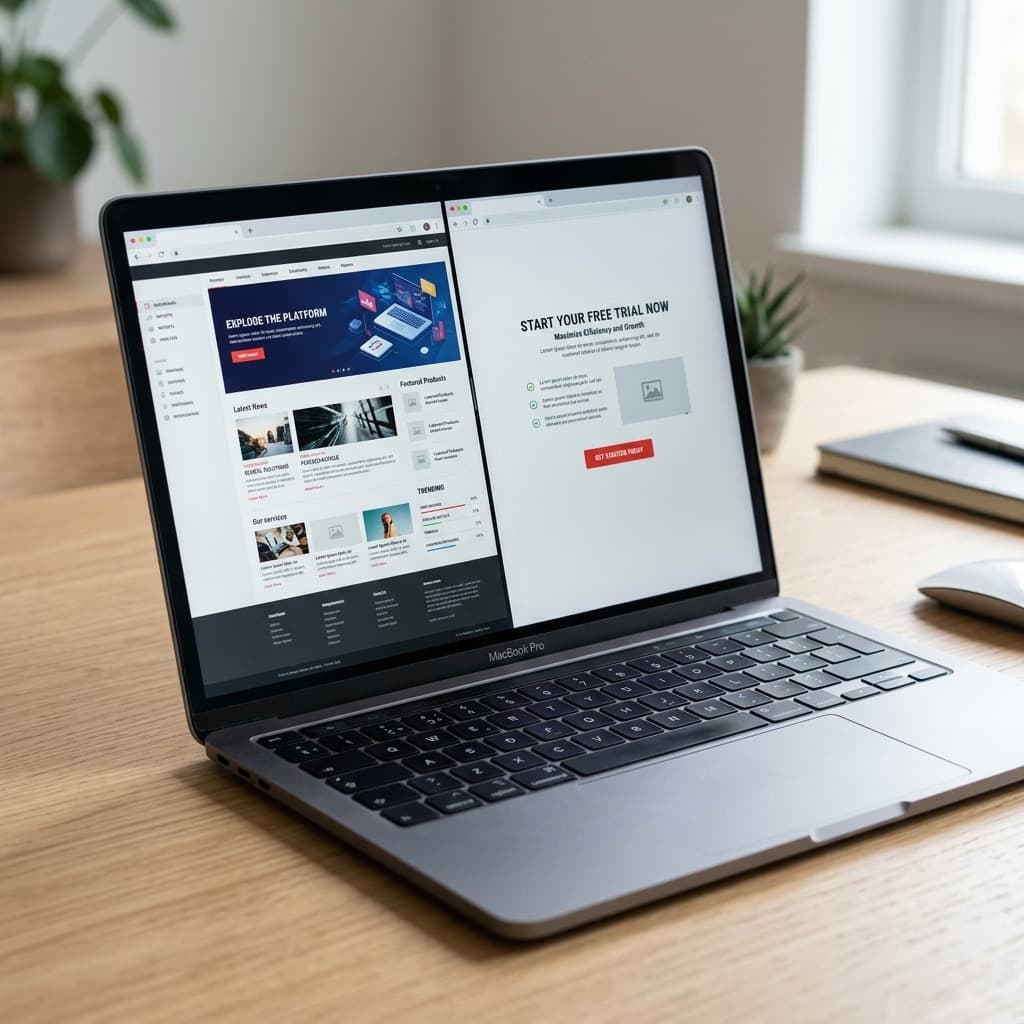
Landing Page vs. Homepage: Which Should Get Your Ad Traffic?
Tanvir Mahedi
Author
If you're running paid ads and sending that traffic to your homepage, the data on what that's actually costing you is more dramatic than most small businesses expect. Here's what the numbers say, and why the gap is as big as it is.
The Conversion Rate Gap Is Real and Well-Documented
Unbounce's Conversion Benchmark Report — built from 464 million visits across 41,000 landing pages, one of the largest datasets on this specific question — puts the median landing page conversion rate at 6.6%, while homepages receiving ad traffic commonly convert at just 1–2%. Other industry sources report homepage conversion holding steady around 2–3% against landing pages regularly hitting 6–11% for well-built pages, and some report an even wider gap. The exact numbers vary somewhat by source and industry, but every credible dataset agrees on the same direction and the same rough order of magnitude: a dedicated landing page substantially outconverts a homepage for the same ad traffic, typically by a factor of three to six.
Why the Gap Is This Big
The mechanism is called message match, and it's simpler than it sounds: someone clicks an ad promising one specific thing, and the page they land on should be about that one specific thing — not a general homepage covering everything your business does, where they now have to hunt for the offer they actually clicked for. A homepage is built to serve every kind of visitor at once: new customers, returning customers, job applicants, people who typed your name into Google directly. An ad click is not a general visitor — it's someone who already expressed one specific intent, and a page that immediately confirms "yes, you're in the right place, here's exactly what you clicked for" converts dramatically better than one that makes them re-orient themselves first.
The Gap Varies by Where the Traffic Comes From
Not all ad traffic behaves the same way once it lands. Visitors from pay-per-click search ads convert at roughly 10.9% on a well-matched landing page, while paid social traffic converts around 12.0%. Email traffic converts highest of all at roughly 19.3% — and notably, landing page visitors arriving from email convert about 60% more than visitors arriving from paid social. That's a useful signal for where to prioritize landing-page quality first if you're running multiple channels: the better the intent going in, the more a focused landing page multiplies it.
There's a Cost Benefit Too, Not Just a Conversion Benefit
This isn't only about conversion rate. A dedicated landing page with strong message match also tends to improve your ad platform's Quality Score, which directly lowers your cost per click — meaning the same ad budget both converts better per visitor and often costs less per visitor to begin with. The two effects compound: more conversions, from more visitors, at a lower cost to acquire each one.
When a Homepage Is Actually Fine
This isn't an argument that homepages are bad — a homepage is doing a genuinely different job. It needs to serve everyone: explain who you are, cover your full range of services, and work as a hub for every kind of visitor with different intents. That's exactly the job a homepage should do — and exactly the job that makes it a weak landing spot for an ad that promised one specific, narrow thing. Organic search traffic, direct visitors, and word-of-mouth traffic arriving with mixed or unclear intent are well served by a homepage. Traffic that already clicked on one specific promise is not.
The Practical Takeaway
If you're running any paid campaign — search, social, or otherwise — promoting a specific offer, service, or launch, a dedicated landing page built around that one thing is close to a default best practice at this point, not an optional upgrade. The conversion-rate data is consistent enough across independent sources that "just send it to the homepage" should be treated as a real, measurable leak in ad spend, not a shortcut that saves time for free.
Sources: Unbounce Conversion Benchmark Report (464M visits, 41,000 landing pages); 2026 landing page and homepage conversion-rate research; paid traffic source conversion-rate benchmarks by channel.
Keep reading
How Much Does a Website Redesign Cost? A Small Business Guide
The honest answer is "it depends" — but here's what real industry survey data says small businesses actually spend, and why the cheapest option often costs more in the long run.
Website vs. Web App: Which Does Your Small Business Actually Need?
They sound similar, but they solve different problems. Here's how to tell which one your business actually needs — and when you need both.
What Is AI-Assisted Development? (And Why It's Faster, Not Riskier)
"AI-built" sounds risky if you picture code with zero human oversight. That's not what this is — and the real research on AI coding tools is more nuanced than either the hype or the skepticism suggests.
What Website Downtime Actually Costs a Small Business
A few hours of downtime sounds like a minor inconvenience — until you look at what it actually costs, and how often it happens to sites nobody's watching.
How Often Should a Small Business Blog? What the Data Actually Says
"Post more" isn't wrong, but it's not the whole answer either — here's what the actual traffic data says about how often a small business should be publishing.
Schema Markup Explained: How AI Search Engines Decide What to Cite
Getting cited by ChatGPT or Perplexity isn't random — there's a specific, well-documented technical reason some pages get picked as sources and others don't.
Core Web Vitals Explained: What Google Actually Measures
"Site speed matters for SEO" is old advice. What changed is that Google now measures it with three specific metrics — and in 2026, missing the bar has a real, measurable ranking cost.
Website Maintenance Checklist: What Actually Needs to Happen Every Month
"Set it and forget it" is how most small-business websites get hacked or quietly break. Here's what monthly maintenance actually involves, and how long it really takes.
Website Builder vs. Custom Development: When Templates Stop Working
A $30/month website builder isn't always the cheap option it looks like. Here's the honest math on when a template is genuinely fine, and when it starts actually costing you.
AI Product Photography: What It Can't Replace About a Real Photo Shoot
AI product photography is genuinely good — and genuinely limited. Here's an honest breakdown of what it replaces, what it doesn't, and why the best results mix both.
Brand Identity and Website Design: Why They Should Be Done Together
A logo from one designer and a website from someone else, six months apart, is one of the most common — and most avoidable — ways small businesses end up with a brand that fights itself.
How to Choose a Web Design Agency: Real Red Flags to Watch For
Most bad agency hires were avoidable — the warning signs were visible before signing, just easy to miss if you don't know to look for them.
What a Freelancer or Photographer Portfolio Site Actually Needs
A beautiful gallery of work isn't a complete portfolio site — here's what's actually missing from most freelancer and photographer sites, and why it's costing them clients.
"AI-Drafted, Human-Edited": What That Workflow Actually Means
"AI-drafted, human-edited" gets said a lot without much explanation of what it actually means — here's the real workflow, and why the human part is doing more work than it sounds like.
Related services
Let's build something that works.
Tell us about your project — we'll get back to you with a straight answer, not a sales pitch.